



0030. 类型作用域
- 1. 🎯 本节内容
- 2. 🫧 评价
- 3. 🤔 什么是 TypeScript 中的类型作用域?
- 4. 🤔 TypeScript 中类型作用域遵循什么规则?
- 5. 🤔 TypeScript 中模块作用域是如何工作的?
- 6. 🤔 TypeScript 中全局作用域有什么特点?
- 7. 🤔 如何安全地扩展全局作用域?
- 8. 💻 demos.1 - TypeScript 是如何识别文件是一个模块还是全局脚本的呢?
- 9. 🤔 TypeScript 中
namespace命名空间的作用域是什么样的? - 10. 🤔 TypeScript 中如何处理同一个作用域下的同名的
interface、class、type呢? - 11. 🔗 引用
1. 🎯 本节内容
- 类型作用域
- module
- script
- moduleDetection
- namespace
- class
- type
- declare global
2. 🫧 评价
- 涉及到的关键术语蛮多的,它们大多都跟 TS 的类型作用范围相关,其中很多内容会在后续学习中接触到。
- TS 中类型作用域遵循的规则和 JS 中的 let、const 变量很相似,都具备块级作用域的特性。
- 但是在 TS 中,同一个作用域下的同名成员,有时候会合并(比如
interface跟同名的interface、class),有时候会直接报错(比如同名的type跟interface、class)。 - module 和 script 的区别是一个不易发现的细节,需要知道 TS 的模块检测策略是可以通过
moduleDetection进行配置的。
3. 🤔 什么是 TypeScript 中的类型作用域?
- 本节介绍的类型作用域,主要是指“类型的作用范围”。
- 类型作用域是一个社区概念。
- 在 TS 官方文档中并没有专门的篇幅来介绍 Type Scope,类型作用域是社区自创的一种概念。
- 在 TypeScript 中,并没有一个官方术语叫“类型作用域”(Type Scope),但这个说法通常被开发者用来描述类型声明的可见性范围,即:在哪些地方可以访问某个类型(如
interface、type、class、enum等)。
- 虽然 TypeScript 本身没有独立的“类型作用域”机制(类型最终会被编译器擦除,不参与运行时),但类型的作用域规则完全遵循 JavaScript/TypeScript 的词法作用域(Lexical Scope)和模块系统。
4. 🤔 TypeScript 中类型作用域遵循什么规则?
TypeScript 中的类型(type、interface、class、enum 等)遵循与变量相同的块级作用域或函数作用域规则。
- 块级作用域(Block Scope)
{
  type User = { name: string }
  const u: User = { name: 'Alice' } // ✅ 可访问
}

// ❌ 错误:User 仅在块内可见
const v: User = { name: 'Bob' }

// 类似 let/const,type 和 interface 在块内声明时,只在该块内有效。- 函数作用域
function createProcessor() {
  interface Config {
    timeout: number
  }

  return function (config: Config) {
    // ✅ Config 在函数内部可见
  }
}

// 外部无法访问 createProcessor 内部定义的 Config 接口
const p = createProcessor()
p({ timeout: 1000 }) // ✅ 调用没问题,但不能显式标注类型
// p(config: Config) ❌ Config 未定义5. 🤔 TypeScript 中模块作用域是如何工作的?
TypeScript 默认采用 ES 模块系统(每个文件是一个模块,只要包含 import/export)。
- 未显式导出的类型是模块内私有的。
// user.ts
// 此时 User 是 user.ts 模块内私有类型(默认行为)
interface User {
  id: string
  name: string
}

export function createUser(name: string): User {
  return { id: generateId(), name }
}

// 在这个文件中:
// User 是模块私有 的,外部无法直接引用。
// 但返回值类型 User 会被隐式导出,调用者可安全使用,但不能显式声明 User 类型变量。

// main.ts
import { createUser } from './user'

const user = createUser('Alice') // user 类型被推断为 { id: string; name: string }
// const u: User = ...; // ❌ 找不到 User(未显式导出)- 如果外部需要访问模块内的私有类型,可以考虑将类型显式导出。
// user.ts
// 可以将 User 类型显式导出类型
export interface User {
  id: string
  name: string
}

export type UserId = string

// main.ts
import { User, UserId } from './user'

const u: User = { id: '1', name: 'Alice' } // ✅6. 🤔 TypeScript 中全局作用域有什么特点?
特点:没有 import / export 的模块
如果没有 import / export 的模块,将被 TypeScript 默认视为全局脚本。
// 全局模块存在被全局污染风险

// bad.ts(无 import/export)
interface Config {
  debug: boolean
}

// another.ts(无 import/export)
interface Config {
  apiUrl: string
}

// 这两个 Config 会自动合并(Declaration Merging),变成:
interface Config {
  debug: boolean
  apiUrl: string
}

// 这容易导致意外冲突,现代项目应始终使用模块(即每个文件至少有一个 export)。7. 🤔 如何安全地扩展全局作用域?
TypeScript 允许通过 declare global 安全扩展全局作用域:
// global.d.ts
export {} // 确保这是模块

declare global {
  interface Window {
    myApp: {
      version: string
    }
  }
}接下来就可以在任何模块中使用:
window.myApp.version // ✅ 类型安全8. 💻 demos.1 - TypeScript 是如何识别文件是一个模块还是全局脚本的呢?
在回答这个问题之前,需要先明确一下,TypeScript 中有两种类型的模块:
- 局部模块 -> 官方的叫法是
module - 全局脚本 -> 官方的叫法是
script
我们前面提到的,如果一个模块中含有 export 或 import 这样的模块化语句,那么按照 TS 的模块解析策略,就会将其识别为 module,反之识别为 script。
// 问题场景描述:
// 当你在学习 TS 的时候,在本地新建了俩文件,比如叫 1.ts 和 2.ts
// 你在 1.ts 中声明了一个 a 变量

// 1.ts
let a = 1

// 当你在 2.ts 中也声明了一个 a 变量之后(你会发现两个模块都出现了报错)

// 2.ts
let a = 1

// 这时候你往往会遇到这么一个错误:无法重新声明块范围变量“a”。ts(2451)
// 并且该错误同时出现在了 1.ts 和 2.ts 文件中。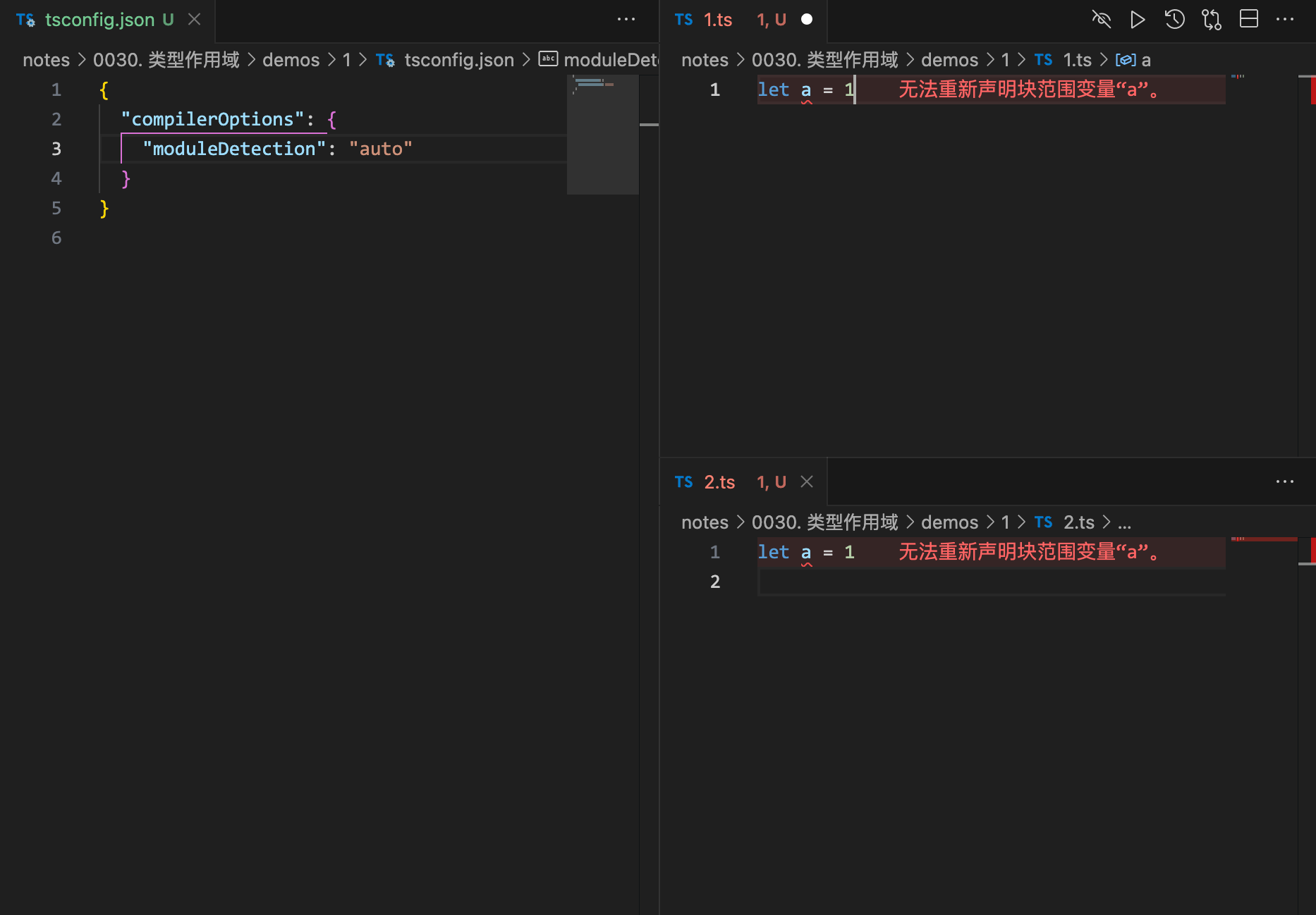
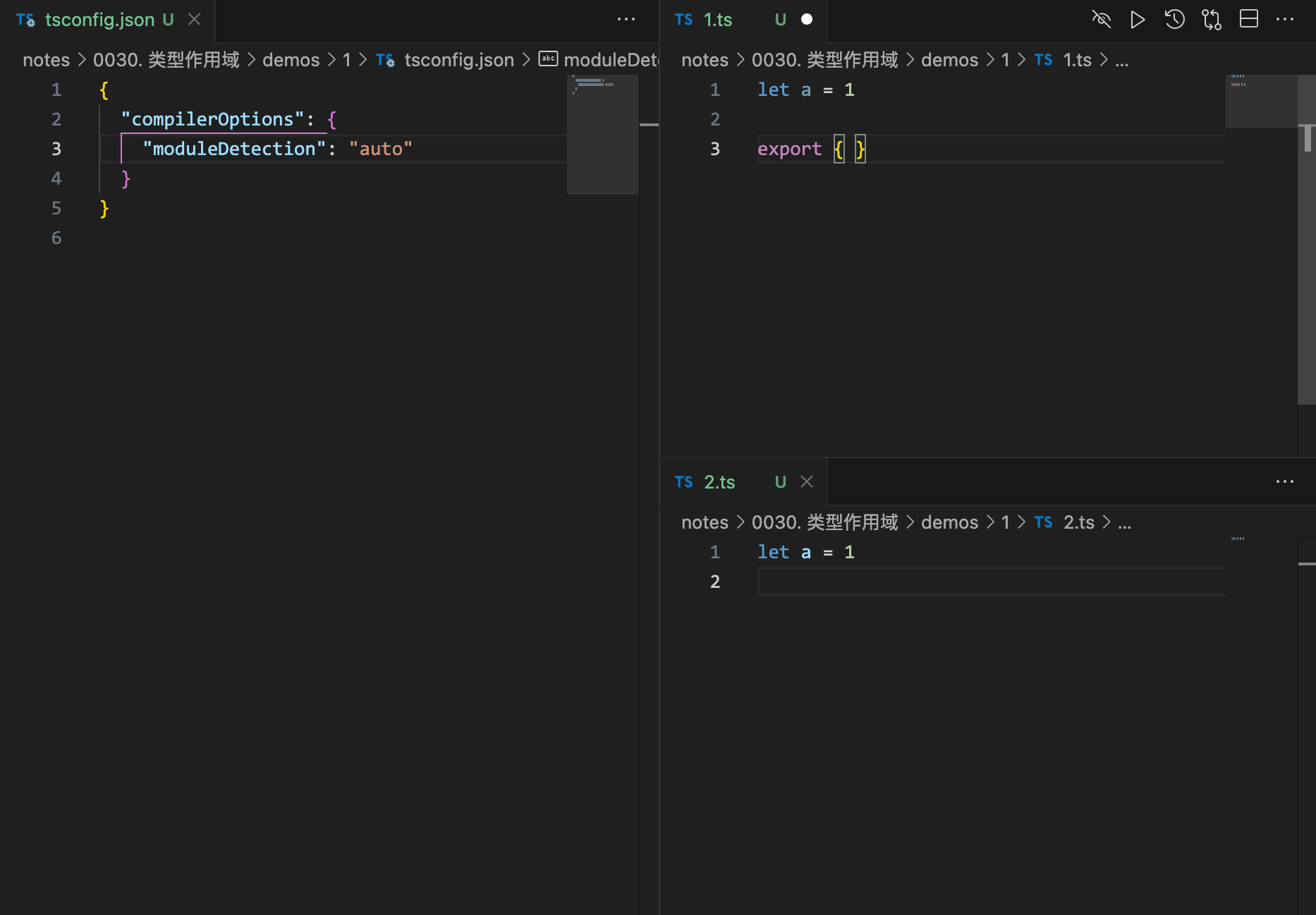
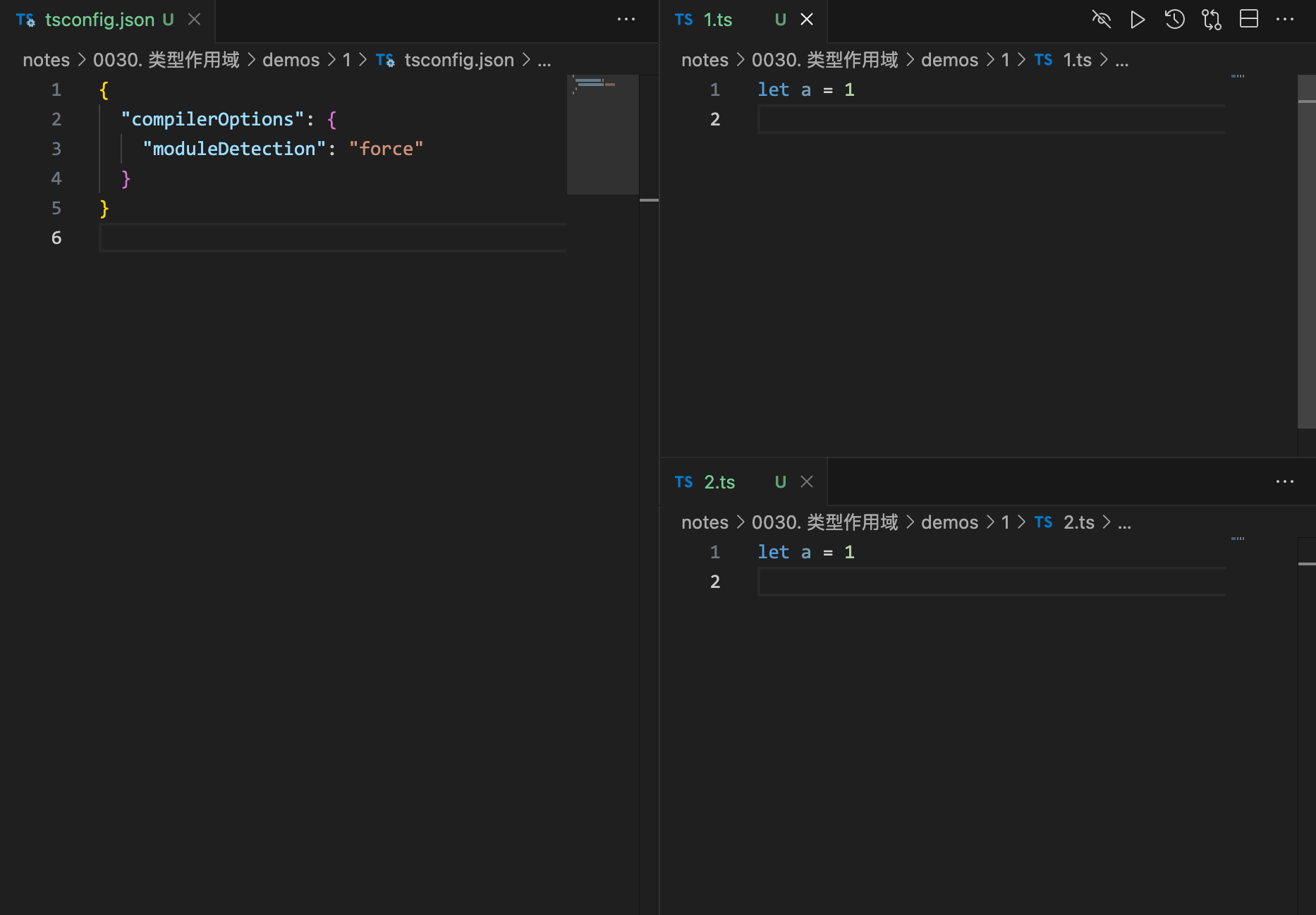
当你遇到上面这个问题时,在很多教程中,会教你这么做:你只需要在任意模块中添加一条模块化语句即可,比如:export {},这么做确实能够解决报错的问题,但是这么做显得不那么优雅,我这就是一个简单的测试模块,为什么非得在每个模块都加上这样无意义的一条语句呢?
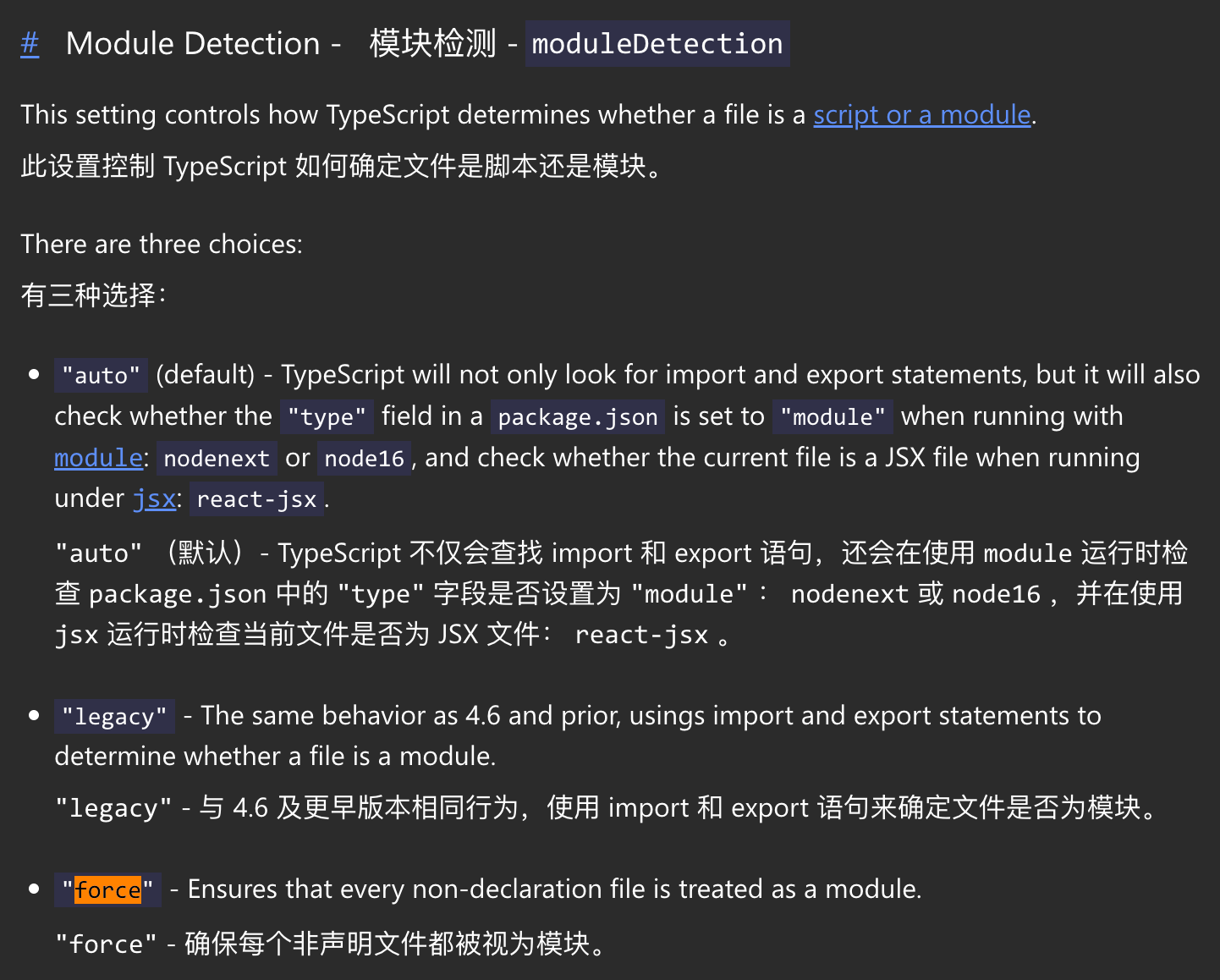
实际上,这个模块检测的策略是支持配置的,并不是非得加模块导入导出语句才能让你的文件被 TS 识别为一个 module。在 TS 配置文件中有这么一个字段 moduleDetection,它就是用来控制 TS 如何确定文件是 script 还是 module 的。
上述报错的主要原因在于,1.ts、2.ts 都被 TS 视作了 script,而不是 module,因此 TS 认为你的代码虽然写在两个不同的文件中,但最终会合并到同一个全局上下文中执行,而你重复声明了变量 a,自然就报错了。
以下是官方对于 moduleDetection 配置的描述:
9. 🤔 TypeScript 中 namespace 命名空间的作用域是什么样的?
namespace是一种将相关代码组织在一起的方式,中文译为“命名空间”。namespace出现在 ES 模块诞生之前,作为 TypeScript 自己的模块格式而发明的。但是,自从有了 ES 模块,官方已经不推荐使用namespace了。- 早期 TypeScript 使用
namespace组织代码(类似模块),但现在推荐使用 ES 模块。
namespace API {
  export interface User {
    id: string;
  }

  export function fetchUser(): User { ... }
}

// 使用
const u: API.User = ...;❌ 不推荐原因:
- 与现代模块系统(ESM/CommonJS)不兼容
- 打包工具(如 Webpack)支持差
- 官方文档建议“仅用于描述现有 JS 库的类型”
10. 🤔 TypeScript 中如何处理同一个作用域下的同名的 interface、class、type 呢?
interface可以与interface、class合并type别名不能与任何类型同名
- 模块内的同名
interface会自动合并
// 在同一文件
interface User {
  name: string
}

interface User {
  email: string
}

// 合并为 { name: string; email: string }- 跨模块合并
interface的做法
// global.d.ts
interface User {
  id: string
}

// utils.ts(必须是全局脚本,或通过 declare global)
interface User {
  createdAt: Date
}

// 在不同模块中,这些跨模块的 interface 不会自动合并。
// 解决方案:
// 1. 显式导出并导入
// 2. 显式全局声明 declare global
// 目的都是为了让它们在同一个作用域中interface可以跟class合并
class User {}
interface User {
  age: number
}

const u = new User()

u.age // => numbertype别名不能与任何类型同名
class User {} // 声明了一个类型 User 和一个值 User(构造函数)
// 注意:TS 中的类本身就是一种类型。

type User = string // ❌ 错误!不能与 class 同名(值和类型冲突)
// Duplicate identifier 'User'.(2300)

// -----------------------------------

interface User {
  name: string
}
type User = string // ❌ 错误!Duplicate identifier 'User'.(2300)

// -----------------------------------

// 值(变量 User)和类型(类型别名 User)的名称不会冲突
const User = 'admin'
type User = string // ✅ ok