



0288. readonly 数组在函数参数中的兼容性差异分析
1. 🎯 本节内容
- readonly 数组在函数参数中的类型兼容规则
2. 🫧 评价
这篇笔记的核心只探讨一个问题:“如果使用只读数组约束函数参数,那么该参数可以接收普通数组吗?”
理清楚这个问题,可以帮我们更好地理解逆变策略。
先给出结论:函数参数的“逆变”只在函数类型赋值时生效。而在函数调用时,TypeScript 采用“单向兼容”检查,因此允许将 number[] 传给 readonly number[] 参数。
3. 🤔 如果使用只读数组约束函数参数,那么该参数可以接收普通数组吗?
3.1. 先说答案
答:得具体看是函数赋值还是参数赋值。
- 函数赋值:只读数组参数「不可以」接收普通数组
- 参数赋值:只读数组参数「可以」接收普通数组
3.2. 知识点回顾
💡 知识点回顾:
- 协变策略:子可以赋值给父,父不能赋值给子;
- 逆变策略:父可以赋值给子,子不能赋值给父;
- 函数的参数采用的是逆变策略;
readonly number[]是父,number[]是子;
根据上述知识点,我们会得到这样一条结论:逆变策略下,子(number[])不能赋值给父(readonly number[]),因此如果在函数参数中使用只读数组进行约束,不能传入普通数组。
3.3. 示例 1 - 满足结论
ts
type FuncWithReadonly = (a: readonly string[]) => void
type Func = (a: string[]) => void

let f1: FuncWithReadonly = (a: readonly string[]) => {}
let f2: Func = (a: string[]) => {}

f2 = f1 // ✅ 兼容
// f1 = f2 // ❌ 不兼容
// 报错信息:
// Type 'Func' is not assignable to type 'FuncWithReadonly'.
//   Types of parameters 'a' and 'a' are incompatible.
// The type 'readonly string[]' is 'readonly' and cannot be assigned to the mutable type 'string[]'.(2322)常规逻辑:
- 父类型是:
readonly string[] - 子类型是:
string[] readonly string[] = string[]✅- 类比:可读可写的编辑器可以被用作只读的编辑器;
string[] = readonly string[]❌- 只读的编辑器无法被用作可读可写的编辑器;
用在函数参数层面,正好反转:
readonly string[] = string[]❌string[] = readonly string[]✅
3.4. 示例 2 - 与结论冲突
ts
// 参数约束为只读数组
function sum(numbers: readonly number[]): number {
  return numbers.reduce((total, n) => total + n, 0)
}

// 参数约束为普通数组
function badSum(numbers: number[]): number {
  return numbers.reduce((total, n) => total + n, 0)
}

const arr1 = [1, 2, 3]
const arr2: readonly number[] = [1, 2, 3]

sum(arr1) // ✅ 可以传入普通数组【⚠️ 注意:这里和我们得出的结论冲突】
sum(arr2) // ✅ 可以传入只读数组

badSum(arr1) // ✅ 可以传入普通数组
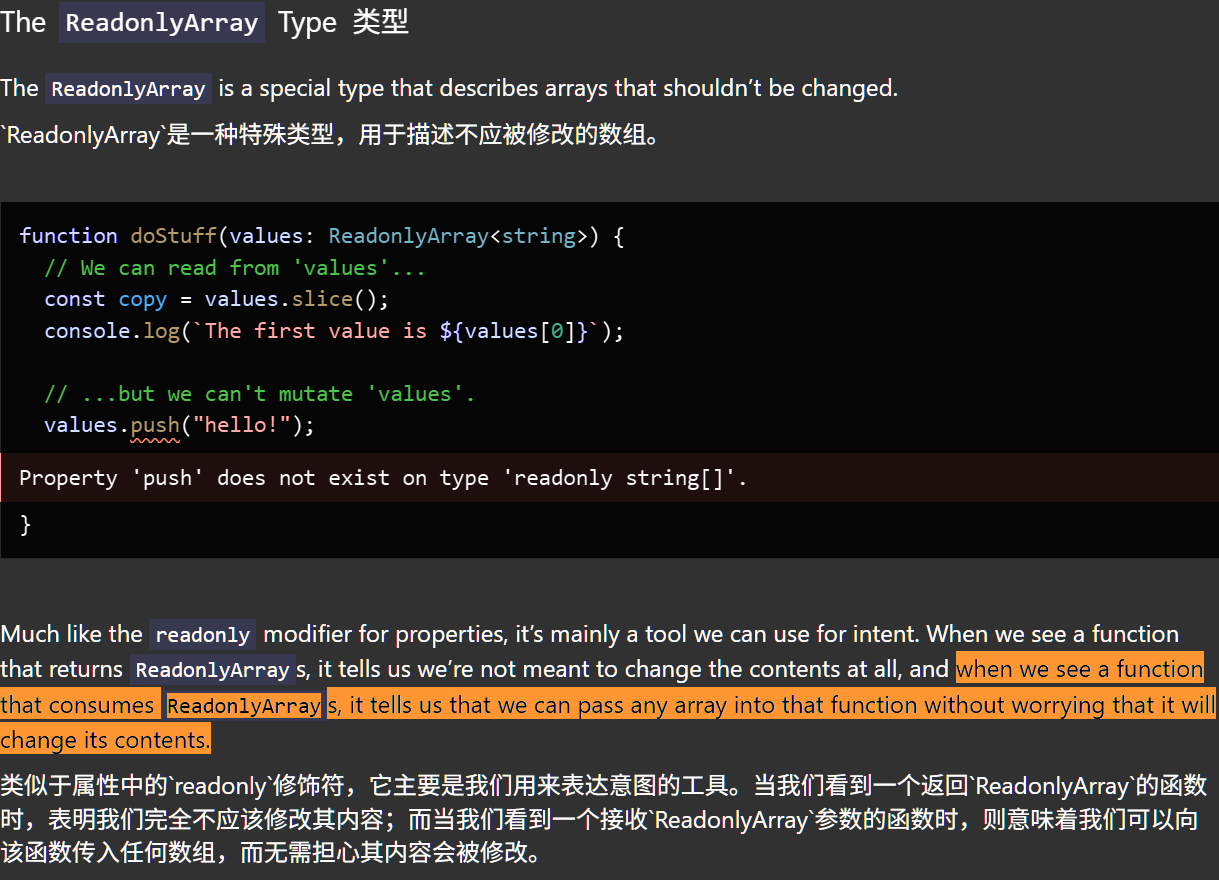
// badSum(arr2) // ❌ Error: readonly 不能赋值给 mutable官方原话:when we see a function that consumes ReadonlyArrays, it tells us that we can pass any array into that function without worrying that it will change its contents.
3.5. 现象分析
在前面的示例中,我们发现了一个看似“违反类型系统逻辑”的现象:
- 函数类型层面(示例 1)
(a: readonly string[]) => void和(a: string[]) => void互不完全兼容。- 参数位置受逆变规则约束,因此:
- ✅
string[] = readonly string[](子赋给父)是允许的; - ❌
readonly string[] = string[](父赋给子)是不允许的。
- ✅
- 调用层面(示例 2)
function sum(numbers: readonly number[])竟然可以被传入一个number[]。- 这似乎与“逆变”相矛盾。
3.6. 解释说明
这是“函数类型赋值”与“函数调用传参”的概念差异导致的。
- “函数类型赋值”:这是两个函数签名之间的兼容性问题 -> 要遵循“逆变策略”
- “函数调用传参”:这是值层面的赋值问题 -> 要遵循“协变策略”
二者的关键区别:
| 对比点 | 函数类型赋值 | 函数调用传参 |
|---|---|---|
| 赋值对象 | 函数与函数之间 | 值与函数参数之间 |
| 检查策略 | 逆变 | 协变 |
readonly T[] 参数能否接受 T[] | ❌ 不行 | ✅ 可以 |